How Is the Myth or Story Represented in This Piece of Art?
For thousands of years, an fine art form has existed that includes works in a wide range of media, including bawl painting, ceremonial clothing, painting on leaves, stone carving, watercolor painting, and wood carving. This art form is known equally Indigenous Aboriginal Art and pre-dates European colonization.
Initially created by the Aborigines who first settled in Commonwealth of australia, with the passage of time collaborations from other civilizations have besides been included in the collection. Since the Aborigines did not have a written language back so to communicate, much of their cultural heritage and passing downwardly of data to newer generations was through this remarkable art form.
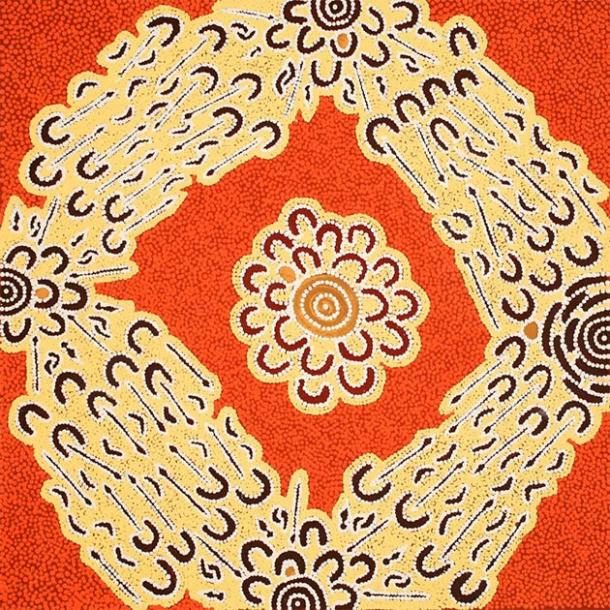
This Jajirrdi and Janganpa Jukurrpa (western quoll and common brush-tail possum Dreaming is based at Yakurdiyi, a cave and rock hole south-east of Yuendumu. ( © Ritasha Nampilinpa Watson / ArtArk )
The Aboriginal Fine art of Telling a Story
Aboriginal art is centered on storytelling . That is why nosotros observe much of their fine art based on symbols and icons that stand for different elements within their civilization and stories. Many of these symbols retain their meanings across different regions, while the contextual meaning within a painting may be field of study to change. Much of the art available and discovered by archaeologists uses an aerial perspective.
Much of this is now existence reinterpreted into formalism acts, songs, and other traditions through painstaking report and conscientious analysis.
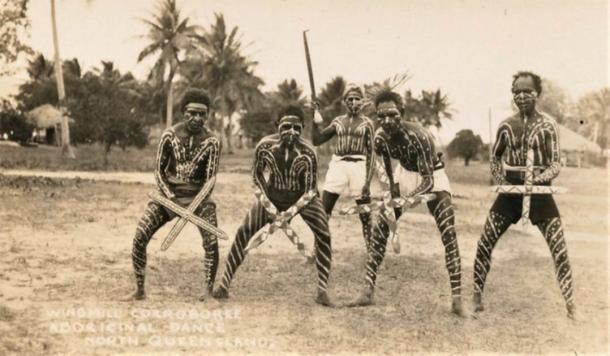
Windmill Corroboree, Aboriginal Dance, Northward Queensland - very early 1900s. ( Public Domain )
Recognition for the Oldest Form of Art
According to a recent study published by Artistic Spirits, the highest toll that an Aboriginal painting could fetch in 1990 was around $ten,000. However, all of this changed with time every bit in 2008; an Aboriginal painting was sold for a whopping $2.v million.
Furthermore, the almanac worth of the Ancient Arts Market was worth $400 million by 2007. Every year Aboriginal Fine art contributes millions of dollars to the Australian economic system every bit paintings sold at auctions fetch incredibly loftier prices. One of the biggest examples of Aboriginal Art increasing in value over time is that of Johnny Warangkula Tjupurrula'southward painting, known equally Water Dreaming.
The painting was sold for a mere $150 back in 1973; however, by the year 2000, information technology exchanged hands for a spectacular $486,500 cost tag. This is an increase of more than iii,243% in 27 years. By 2010 the Australian regime launched a nationwide Indigenous Art Code that protected artists from dodgy sales practices backed by a committee on behalf of the Ancient Australian Fine art Manufacture.
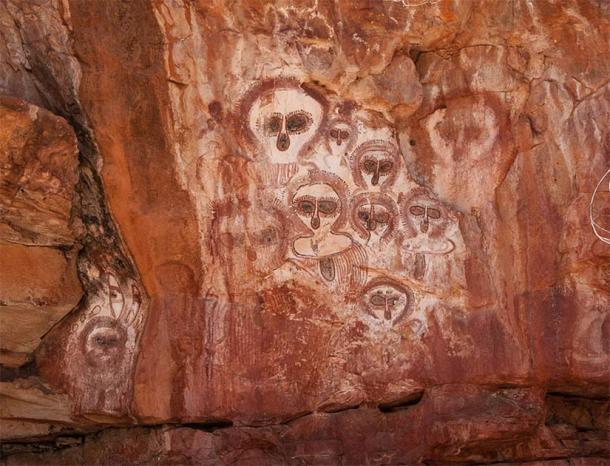
Aboriginal rock fine art on the Barnett River, Mount Elizabeth Station. (Graeme Churchard / CC BY ii.0 )
History of Ancient Fine art
Many critics out there consider Aboriginal Art form as the oldest grade of art. Some consider the Aboriginal culture to appointment back as far as 60,000 to 80,000 years. While Ancient Australians very well may accept been the earliest of settlers in the land, as of the 2016 Australian Census, they comprise just 3.3% of the full population of Australia.
Information technology is widely believed that the oldest of all ancestors of the Aborigine people migrated from Asia during the Pleistocene era.
Earlier extensive European settlement was made possible, it is widely believed that over 250 Aboriginal languages existed. Furthermore, a study by Anders Bergstrom in a 2018 doctoral thesis stated the populations of the region appear to have been genetically contained of the balance of the world since their divergence effectually 50,000 years ago.
Dreamtime
Early anthropologists who discovered aboriginal art form initially for the rest of the world used the term 'Dreaming' that refers to the religious and cultural understanding and worldview associated with Australian Ancient beliefs.
That is why you would hear the term ' Dreamtime' whenever this art form is mentioned as it is attributed to the Aboriginal understanding of the world, how it was created, and various other stories. Hence Dreamtime is oft referred to as the showtime of knowledge from which all other laws of existence sprouted and before long these laws became an obligation and must for survival.
Some natural sites were also considered sacred to the Aborigines. These were the locations where seasonal rituals were performed. During such rituals, the people created fine art to tell stories. While these stories may differ from i region to some other, the Dreaming or Jukurrpa is a common chemical element found in all Aboriginal art.
Many of these included mythical ancestral spirits who were labeled equally creators of both the country and the sky. This is why, in many art pieces, you will always find some spiritual or mythological undertone that refers to Dreaming.
1 tradition that has existed since the earliest Aboriginal Culture and still continues to the present is asking for permission before creating an artwork. Early Aboriginal Artists would depict traditional stories or scared teachings, but in order to do so would kickoff ask their elders within the community before proceeding. Hence through this method, stories beyond generations accept been passed down and some through family lineage besides.
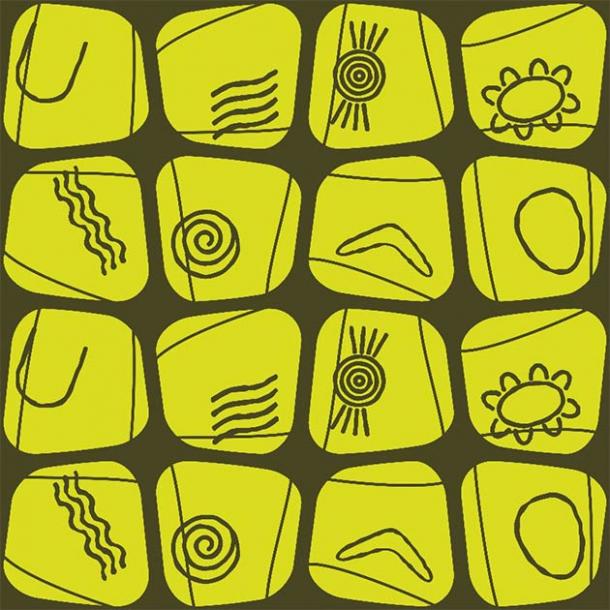
Examples of some of the many symbols of Australian ancient art. ( drutska / Adobe Stock)
Symbolism in Aboriginal Art
Symbolism in Aboriginal Art is a primary focus. Much of these symbols are used to tell stories for children, elders, and even newcomers. Hence in this fine art form, y'all will detect that symbols are put together to tell a story or teach an of import lesson. Yet, there are several distinct styles that can be identified that differ from one region to another.
However, the context of the narrative also comes into play which ways standard symbols can imply dissimilar meanings within the story that is beingness foretold by the original artist. While talking about symbols, nosotros cannot deny or undermine the importance of association symbols.
The formalism utilise of certain clan patterns within this art form is used to link people to a particular association. Clan symbols unremarkably incorporate of the following elements:
- A fine set of lines drawn using specific ochre colors that correspond elements such as fire and water.
- Specific totemic fauna designs that are also included to add greater detail and meanings.
Combining these two features together signifies which clan the possessor of the painting or artwork comes from and moreover, it can exist further studied to link the person's identity closely.
This can be conveyed through the symbols that they use within their art that can relate to their relationship to Dreamtime story as well as their association's mythological beliefs. Contrary to common belief, the symbol used within the drawings and paintings tin can besides be used to stand for deeper meanings and interpretations.
A prime number example can be of the symbol used to represent the budgerigar, which is a type of local parakeet common to Australia. While from an aerial view it portrays a bird as expected but it can also represent indentations on the ground. The budgerigar is also popular in Aboriginal Fine art because back in the day people used this type of bird to guide them to various edible foods besides every bit locating h2o resources.
- The Mysterious Aboriginal Rock Art of the Wandjinas
- Songlines: Mapping the Journeys of the Creation Ancestors in Australia
- 46,000-Year-Former Kangaroo Os Ornament is Oldest Bone Jewelry Ever Found
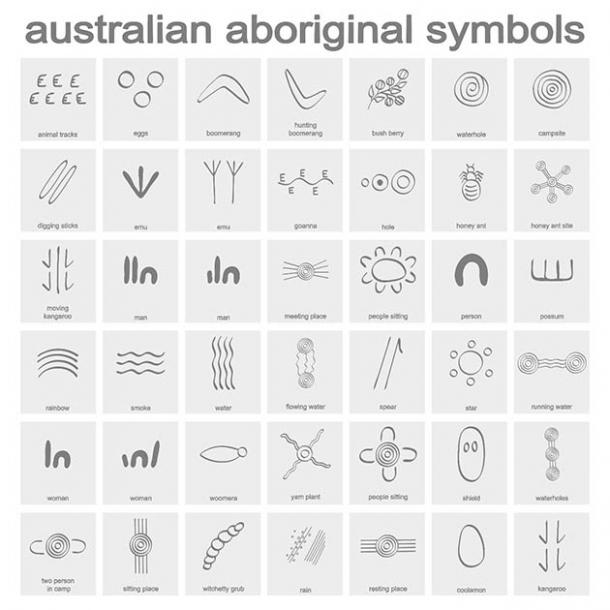
Some of the common Aboriginal symbols and their meanings. ( drutska / Adobe Stock)
Popular Symbols and Their Meanings
To delve further on the subject of symbols and their prominence in Aboriginal Art, let'due south take a quick look at some of the virtually commonly used ones with their meanings for a deeper comprehension regarding their use:
Aboriginal Motifs
Motifs have popularly been used as a recurring element within a narrative that has symbolic significance in a story. By using a motif, i can produce various aspects of the narrative, such every bit mood and theme. In Ancient Fine art motifs are used to depict a lot of things that can relate to actions, inform the viewer near a special ceremony or tradition, and even the plot of the narrative.
For example, many animals in the stories tin can be simply represented by their footprints. Hence if an artist wanted to depict an emu, then they would describe a three-pointed V rail on their painting or cartoon.
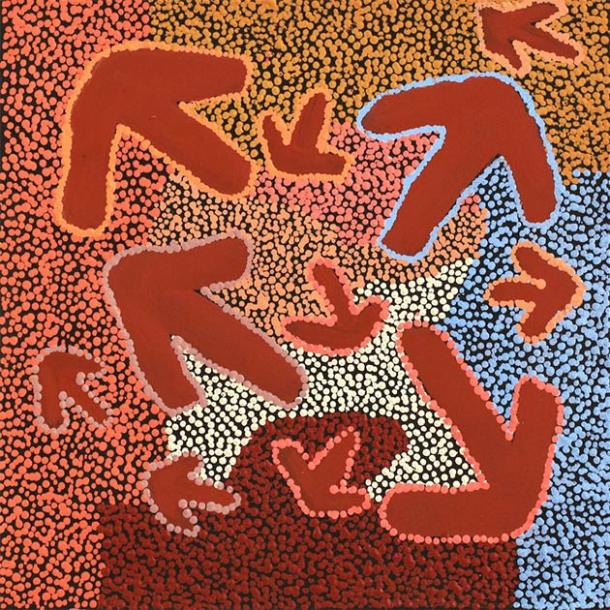
Yankirri Jukurrpa - Emu Dreaming. ( © Margaret Nangala Gallagher / ArtArk )
Another example could that be of several U-shaped or crescent icons placed along the boundary of another symbol that takes the form of concentric circles. This could represent a meeting place attended by a number of people, more on this I will talk over afterward.
Hence essentially one comes to the understanding that the use of Ancient motifs are a marvel to behold because in one case you outset understanding the unlike meanings of various symbols, a painting could literarily represent a thousand words. It is astonishing and almost fascinating that an entire narrative can be told through a painting with unique symbols , and this can surely make you fall in honey with this mesmerizing art form.
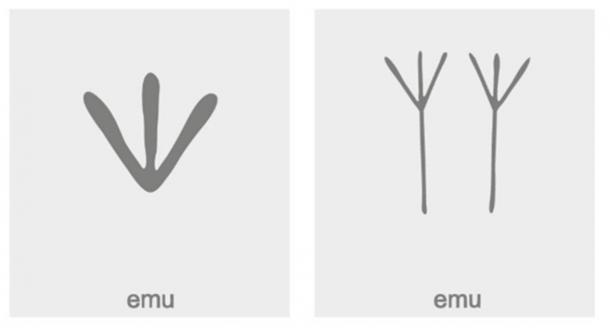
Emu symbols. ( drutska / Adobe Stock)
An Emu
As mentioned earlier, the Ancient symbol for an emu is similar to an arrow that tin can correspond its distinctive three-toed footprint. Emu is the 2nd-largest living bird past height later on the Ostrich.
Australians fairly recognize it equally a native bird which is why many Aboriginal Art forms would ofttimes include the mention of this bird.
Whether it played a vital role in the culture and tradition of the Aborigines requires farther digging. All the same, when we accept into perspective how unremarkably the emu is being represented through this fine art grade generally implies that the emus were quite mutual and in abundance during those times.
But like cats and dogs are popularly owned as a pet, emus must have been a mutual pick of pet back and so. Withal, in a study by ABC News, emus are stated to stand for the creator spirits that used to look over the country according to Aboriginal legends. Many Aboriginal stories besides tell about the big emu in the sky.
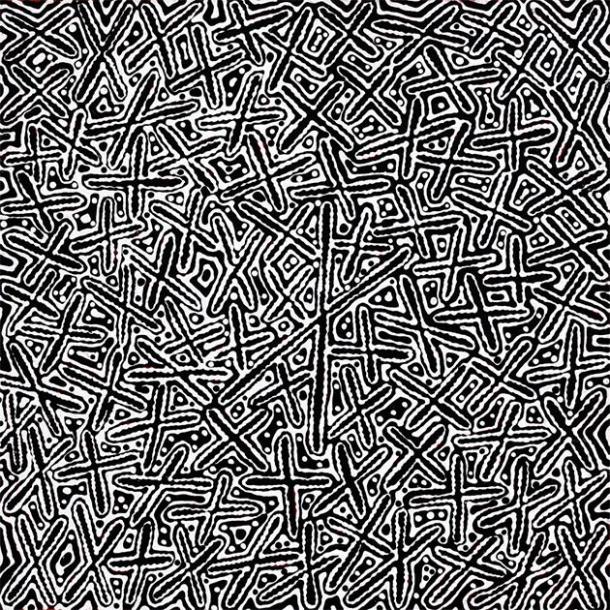
Ngatijirri Jukurrpa - Budgerigar Dreaming ( © Kenneth Jungarrayi Martin / ArtArk )
Budgerigar
Another bird which is commonly mentioned in Ancient Fine art is the budgerigar. These are long-tailed, seed-eating parrots that American English people nicknamed as the parakeet.
Research has found that budgies take survived harsh inland conditions of Australia for over 5 meg years, which is why it is frequently found in the wild. Budgies are known for their nomadic lifestyle and their ability to breed even while they are on the move.
This is why in many Aboriginal Art forms and stories, the budgerigar is often looked by people every bit a sign of hope every bit they are able to locate food and water resources fairly rapidly. The Aboriginal symbol for a budgerigar is a cross that represents a budgerigar that is sitting on the ground, although this aforementioned symbol can also be used to represent other elements within a narrative.
Concentric Circles
Hither is another symbol that can represent a lot of things in this particular fine art grade, and the symbol is that of concentric circles. These can represent specific sites, a coming together place, or even a waterhole.
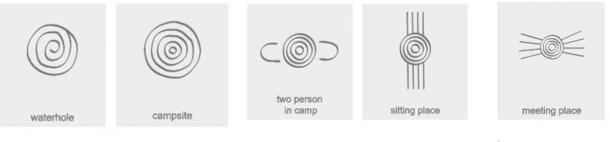
Concentric circle meanings. ( drutska / Adobe Stock)
As i could wait these concentric circles withheld huge importance in the narrative every bit back in the 24-hour interval'southward many formalism sites, also every bit camping sites, were considered the highest level of socialization, as well as their cultural and traditional value, is undeniable for the Aborigines.
For the Aboriginal Australian people living in Key Australia, campsites or meeting places were considered culturally meaning because this is where all public matters regarding a clan would be discussed.
Recall we are talking about a time where at that place were no cinemas, theaters, malls, bars, or whatsoever other modernistic facilities. Hence these sites must have represented the center of all activity within a customs.
Sand Hills
Sandhills are ofttimes found all across the terrain of the Australian continent. This is why much of the Aboriginal Fine art includes the mention of them as culturally and traditionally important for people. The Aborigines used sand hills as a favorite for camping sites and even for hunting activities.
Long and elongated lines are used to correspond the symbol of sandhills in many Ancient paintings. They are often depicted surrounded by a specific site or waterhole which goes to show that they were considered as an important location past clan members and viable spots to settle with family members.
Crescent/U-Shaped Icon
Going through the list of mutual symbols in Aboriginal Art, we also come beyond the crescent or U-shaped icon frequently. This symbol is ordinarily used to correspond people or persons that can be both human or woman, and this is why they can be plant in many Ancient paintings.
They can be further used with other symbols to represent actions, relationships, status in club, and even ceremonial activities.
Hence this symbol has a lot of room available for the creative person to play and create their own narratives. A lot tin can be told through the use of such symbols, and all of this makes Aboriginal Fine art form truly enthralling to report.
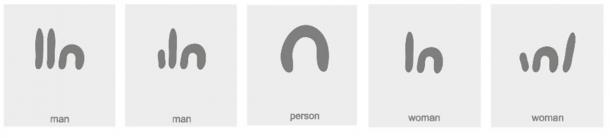
Symbol for Man
The part of men in Aboriginal civilisation was that of a hunter and protector of the family, the association, and settlement spot. They would often travel in groups to hunt large country animals for their resources, and this included birds equally well as kangaroos.
In Aboriginal art form, men are often depicted with a crescent-shaped icon accompanied by a spear or a shield. This could also include other weapons as well, such every bit the boomerang in many instances.
Symbol for Women
The office of women in Aboriginal civilisation was that of main caregiver, and they would often collect eggs, honey, fruits, herbs, nuts, roots, vegetables, and even pocket-size land animals such as snakes. They would indefinitely play a central role for an Aboriginal family unit as well as in the Ancient course of local government and especially in spiritual ceremonies.
They were viewed every bit life-givers in society and thus responsible for the early on socialization of children within the community. A woman in Aboriginal Art course is often represented similar to man; however, their U-shaped icon was accompanied by a digging stick and coolamon rather than traditional weapons to differentiate them.

Kangaroo in art. ( JENNY SOLOMON / Adobe Stock)
The Mighty Kangaroo
Throughout Australia, kangaroos hold a tremendous corporeality of cultural and spiritual significance, especially for the Aboriginal people . Non only was their meat considered to be the staple source of protein, simply fifty-fifty their pelts were used to make habiliment items as well as rugs and skin crafted water bags.
They were represented with a unique symbol almost like an arrow in the Ancient Art form and in some instances, a stroke might be added to their footprint to stand for a tail.
Conclusion
Words are non enough to draw just how startling the Ancient Art form truly is, and in that location is much to be learned withal. These people are what connect us with the ancient world and to the diverse traditions and cultural activities that used to be the norm back in the erstwhile days. I would personally wish to see their folklore and mythologies to be brought to the big screen for the general public to larn more about them.
A motion-picture show, TV series, or animated feature would be great to make us sympathise what Dreamtime actually means. But that is just my personal opinion and the intrigue I feel most the Aborigines. I hope this post was able to excite you as much as me when I outset learned about them. For more questions, feel free to share your thoughts and feedback in the annotate section below. Oh, and read the image description here to find out the story in the top paradigm…
Top image: This detail piece of Aboriginal fine art depicts activity at Ngarlikurlangu, n of Yuendumu. Called 'Yankirri Jukurrpa, (emu Dreaming)' The 'yankirri' (emu) travelled to the rockhole at Ngarlikurlangu to notice water. Source: © Margaret Nangala Gallagher / ArtArk
By Liza Brooke
davidsonengropose.blogspot.com
Source: https://www.ancient-origins.net/history-ancient-traditions/aboriginal-art-0014334
0 Response to "How Is the Myth or Story Represented in This Piece of Art?"
Post a Comment